
Houston Parole Revocation: A Guide for Families & Loved Ones
Houston Parole Guide
Understanding Blue Warrants, Revocation Hearings, and Your Rights
If your loved one is on parole in Houston and has been arrested on a “blue warrant,” you are likely overwhelmed and confused. The parole revocation process is different from a normal criminal trial. It moves faster, the rules are different, and the stakes—a return to the Texas Department of Criminal Justice (TDCJ)—are incredibly high.
This guide answers the most critical questions families ask during this crisis. It is designed to help you understand the path ahead and how an experienced Texas parole lawyer can fight for your loved one’s release.
Step 1
Immediate Crisis: The Blue Warrant Explained
What is a Blue Warrant in Texas?
A Blue Warrant is an arrest warrant issued by the Texas Board of Pardons and Paroles for a parole violation. Unlike a regular arrest warrant issued by a judge, a Blue Warrant is administrative. It is issued when a parole officer alleges that a parolee has violated the conditions of their release, either through a technical violation, such as missing a meeting or failing a drug test, or by committing a new criminal offense.
Once a Blue Warrant is executed, the parolee is taken into custody, usually at a county jail, to await a hearing.
Can you get a bond on a Blue Warrant in Texas?
No. There is no right to bond for a Blue Warrant. Because the individual has already been convicted and is serving a sentence under supervision, the state can hold them without bail while they wait for a revocation hearing.
What is the difference between a technical violation and a new law violation?
A technical violation means breaking a rule of parole. A new law violation means being accused of committing a new crime.
- Technical violations: Examples include failing to report to a parole officer, changing residence without permission, failing a drug test, or traveling outside the permitted area.
- New law violations: These involve being charged with a new misdemeanor or felony offense while on supervision.
- Important note: Even if the new criminal charge is eventually dismissed in court, the Parole Board can still revoke parole if it believes, by a preponderance of the evidence, that the offense occurred.
Step 2
The Revocation Process: Steps and Timeline
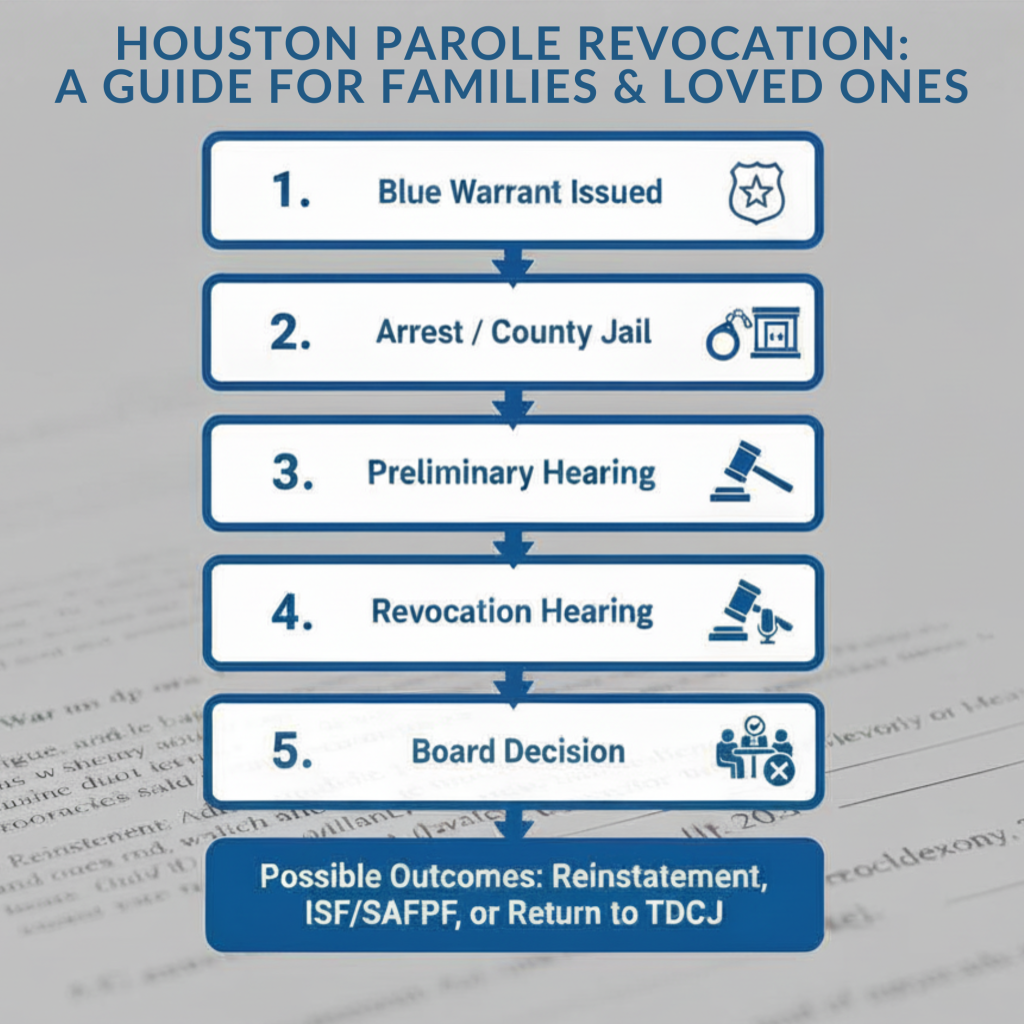
What are the steps of the Houston parole revocation process?
The process typically follows two major stages:
- The preliminary hearing: This determines whether there is probable cause to believe a violation occurred. If the parolee has already been convicted of a new crime or only technical violations are alleged, this step is often skipped. Many parolees are asked to waive this hearing, but you should not waive this right without speaking to an experienced parole attorney first.
- The revocation hearing: This is the main event. It is similar to a trial but is held before a Hearing Officer. Witnesses testify, evidence is presented, and the Hearing Officer makes a final recommendation to the Parole Board.
How long does a parole revocation hearing take to schedule?
Texas law generally requires a hearing to be held within 41 days of the arrest on the Blue Warrant. However, delays can happen. If the violation involves a new criminal charge, the Parole Board may delay the revocation hearing until the new criminal case is resolved in court.
This means your loved one could sit in county jail for months waiting for the criminal case to finish before the parole hearing happens.
Where are revocation hearings held?
Revocation hearings are usually held in the county jail where the parolee is being held. They are not held in a public courthouse. The setting is closed and administrative. The “judge” is a Hearing Officer employed by the Board of Pardons and Paroles.
Step 3
Your Rights and Representation
Does a parolee have the right to a lawyer at a revocation hearing?
Yes. A parolee has the right to hire a private attorney for a parole revocation hearing. While the state provides appointed counsel in some cases, many families choose to hire a private Houston parole lawyer to make sure their loved one has a stronger defense.
What can a lawyer do during a revocation hearing?
A dedicated parole lawyer can actively fight the allegations instead of simply helping the process move forward. Your lawyer can:
- Speak for the client so the accused does not have to answer potentially incriminating questions alone.
- Cross-examine the parole officer and adverse witnesses to find inconsistencies.
- Present evidence of employment, family support, treatment progress, and stability.
- Challenge the validity of drug tests or other technical allegations.
- Propose alternatives to revocation and prison.
Should I waive my preliminary hearing?
Do not waive your preliminary hearing without speaking to a lawyer. Parole officers may present waivers as standard paperwork to speed things up. However, waiving the preliminary hearing can admit that there is probable cause for the arrest. Keeping the hearing preserves your right to make the state prove the basics early in the process.
Step 4
Potential Outcomes After a Revocation Hearing
What are the possible outcomes of a revocation hearing?
The Hearing Officer does not make the final decision. Instead, the Hearing Officer sends a report to the Board of Pardons and Paroles. The Board panel then votes on one of the following outcomes:
- Reinstate parole: This is the best-case scenario. The parolee is released back onto supervision, possibly with modified conditions.
- Intermediate Sanction Facility: The parolee is sent to a secure facility for a short term, usually 60 to 180 days, for rehabilitation or counseling before being released back on parole.
- Substance Abuse Felony Punishment Facility: The parolee is sent to an intensive in-custody drug treatment program, usually followed by a halfway house.
- Revoke to TDCJ: Parole is revoked, and the individual is sent back to prison to complete their sentence. In some cases, they may receive credit for street time, but in other cases, they may lose that credit.
What is street time, and will my loved one lose it?
Street time is the credit a person receives for the time they have spent out on parole. When parole is revoked, the question becomes whether the parolee gets to keep that credit or loses it.
You may lose street time if:
- You are on parole for a Section 149 offense, also known as a 3g offense or deadly weapon finding.
- You have ever been convicted of a Section 149 offense.
- The amount of time you have been on parole is less than the amount of time you served in prison.
You may keep street time if:
- You have spent more time on parole than you served on the current case.
- You have never been convicted of a Chapter 149 offense, 3g offense, or deadly weapon finding.
How We Can Help
Facing a Blue Warrant Does Not Mean Revocation Is Automatic
The Board of Pardons and Paroles looks at the totality of the circumstances. A skilled lawyer can build a narrative of redemption by showing the Board that your loved one has family support, community ties, employment, treatment progress, or other evidence that supports release instead of revocation.
If your family member is currently in custody in a Texas county jail awaiting a revocation hearing, time is critical. We represent clients across Harris County and fight to make sure their voice is heard before the Board makes a final decision.
